PMI · Professional · PMI-PMP
Project Management Professional (PMP)
Independent practice, not affiliated with or endorsed by PMI. Study from the official exam guide.
The real exam
- Questions
- 180
- Duration
- 240 min
- Practice bank
- 681 questions
Start practicing
Exam simulations, quick practice, and block-by-block study of the full bank.
Try 20 free questions · Log in to practice
Exam domains
- People (33%)
- Process (41%)
- Business Environment (26%)
PMP practice exam and simulator
The Project Management Professional (PMP) exam asks you to make judgment calls under time pressure: 180 scenario questions in four hours, most of them asking what a project manager should do next. Reading about project management only gets you part of the way. What helps is answering a lot of realistic questions at exam pace, then working out why the answer you didn't pick was the better one.
Exam Ascent gives you a full-length PMP exam simulator and a large bank of practice questions organized around the current exam's three domains, with an explanation for every answer option.
Try 20 questions free, no sign-up needed. The free set includes every question format used here: multiple choice, multiple response, hotspot, matching, categorization, yes/no and fill in the blank.
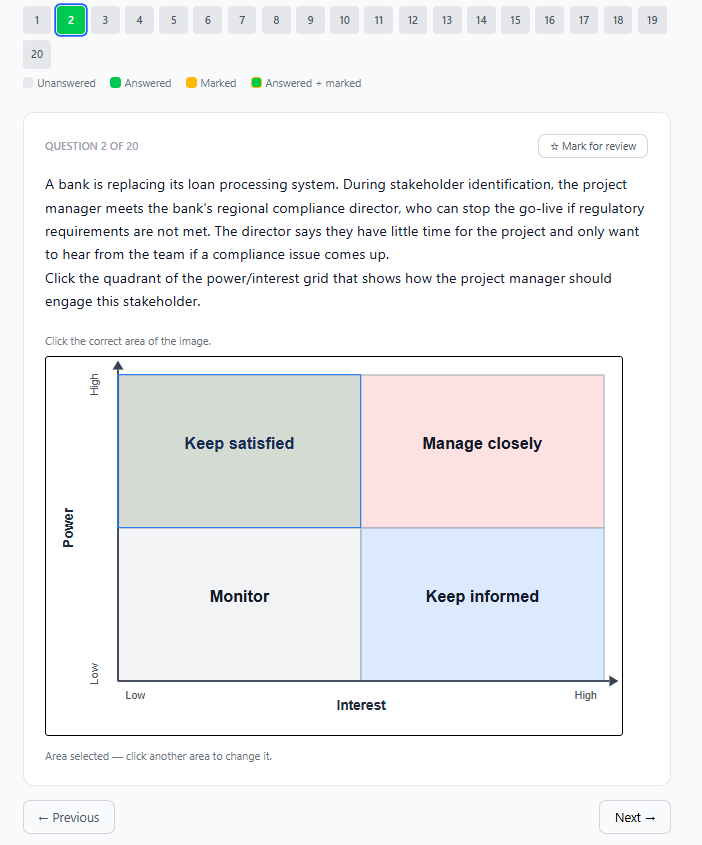
One of the free questions: a hotspot on the power/interest grid.
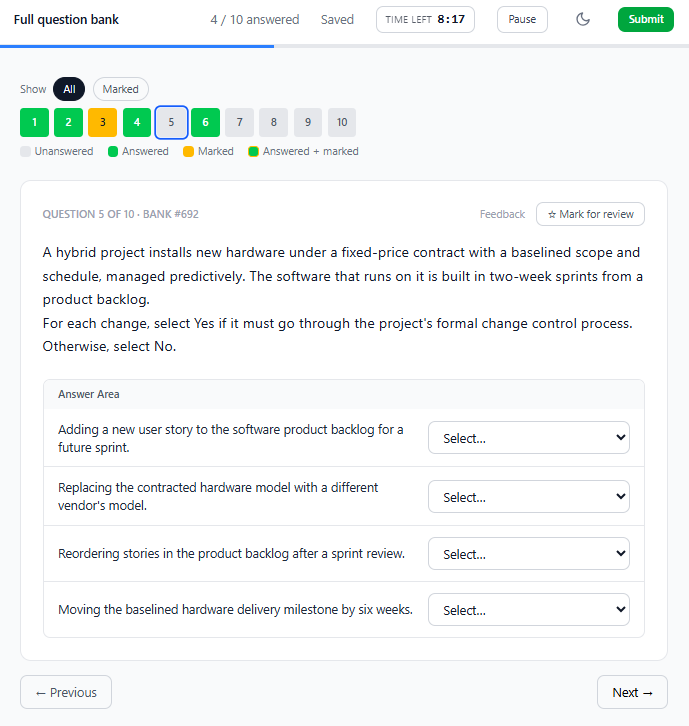
Another question format from the free PMP set: an answer area of dropdowns.
What the PMP exam covers
PMI's exam content outline splits the exam into three domains:
- People (33%): leading and supporting a team, managing conflict, empowering team members, working with stakeholders, and building a shared understanding of the work.
- Process (41%): the technical side of running a project: scope, schedule, budget, risk, quality, procurement, communications, and handling change.
- Business Environment (26%): connecting the project to the organization around it: strategy and value, compliance, governance, organizational change, and the wider context the project operates in.
Questions are spread across predictive (plan-driven) and agile or hybrid approaches, with roughly 40% predictive and 60% agile or hybrid. Expect to switch between them: one question may be about a change control board, the next about a sprint retrospective.
Exam format at a glance
- Questions: 180 (170 scored, 10 unscored pretest questions mixed in)
- Time: 240 minutes
- Breaks: two 10-minute breaks
- Question types: multiple choice, multiple response, drag-and-drop, case-study sets and graphic-based questions
- Passing score: not published by PMI
Check the official PMI exam guide (linked above) before you book. PMI updates the exam from time to time, and its pages are the final word on the format and eligibility rules.
How practice works here
Exam simulation. A full-length set of questions drawn at random from the bank, timed at the real exam's pace. Answer, mark questions for review, and jump around with the question navigator, just as you would on test day. You see your score and every explanation once you submit, never during the test.
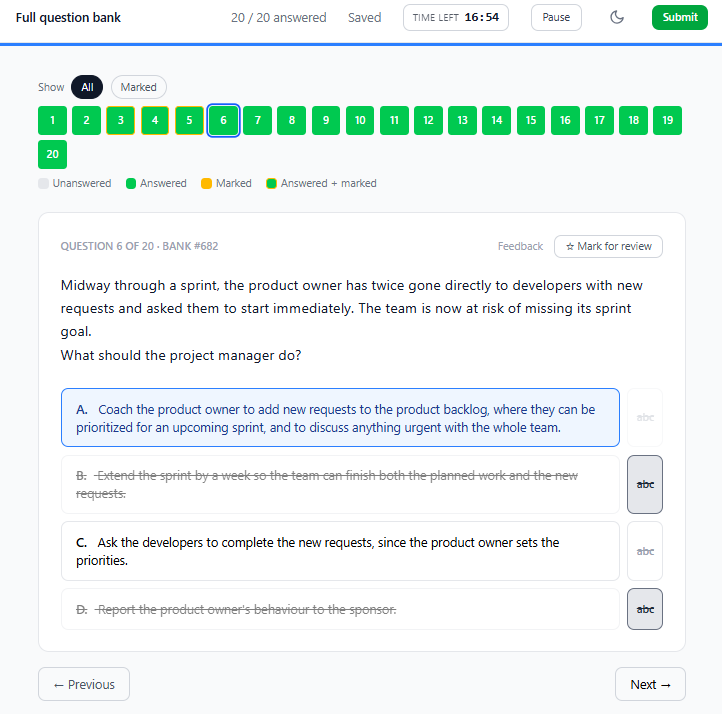
Exam mode: the clock, the question navigator, marked questions and crossed-out options.
Study mode. No timer. Check each answer as you go and read its explanation straight away. Study sessions are kept out of your exam scores, so you can learn without spoiling your progress chart.
Quick practice and blocks. Take a short random set of 10 or 20 questions when you have a few minutes, or work through the whole bank in 50-question blocks.
Explanations for every option. Each explanation says why the right answer is right and why each of the others is wrong. On PMP questions, two answers often sound reasonable; the explanation shows which one PMI's way of working points to and why.
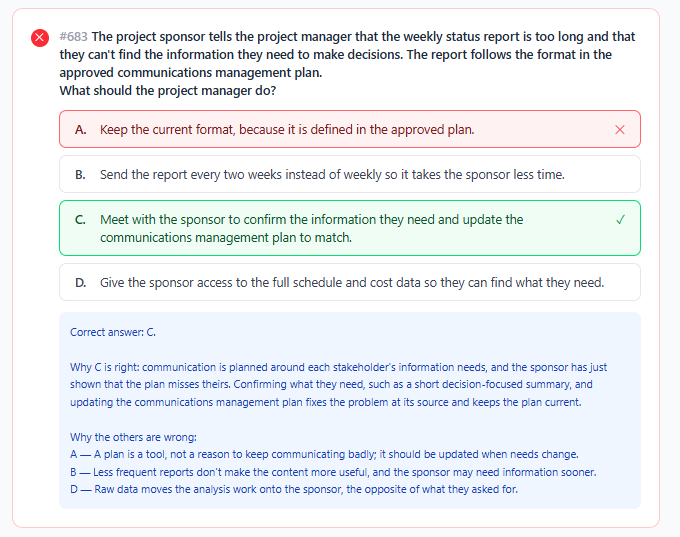
After you submit: your answer, the correct one, and why each option is right or wrong.
All-or-nothing scoring. A multiple-response or matching question only counts when every part of your answer is right, so your score never flatters you.
Your progress. Every attempt is kept with your best, last and average scores, and progress charts show your score and time per question across tests, so you can see whether you're getting more accurate and faster.
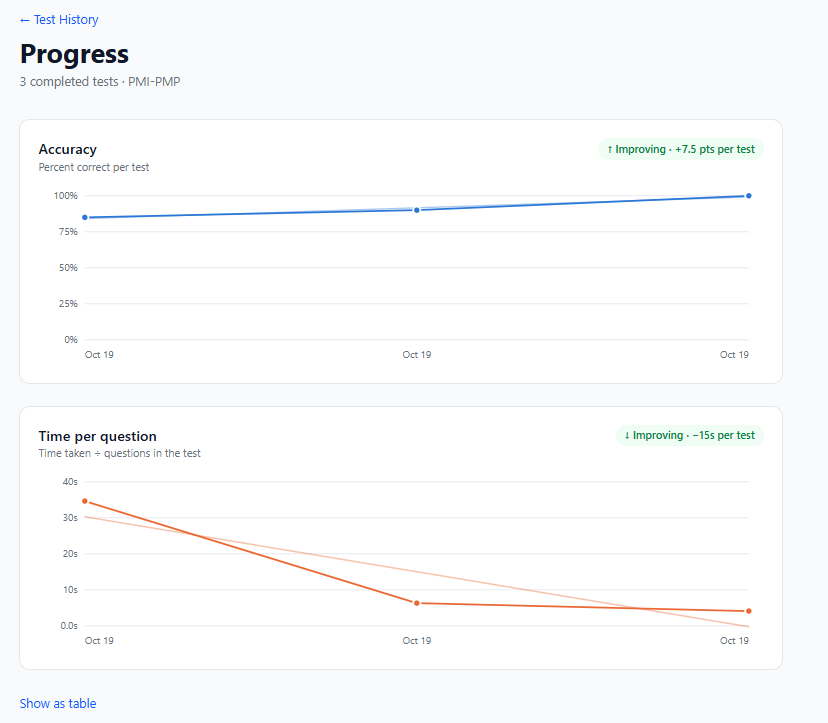
Progress charts: your score and time per question across tests, each with a trend.
Keep going if your connection drops. Answers are kept on your device and saved as soon as you're back online, even if you close the tab.
Tips for using a PMP simulator well
- Take one full simulation early, before you feel ready. It shows which domain needs the most work and how your pace holds up over four hours.
- Review every question you got wrong, and the ones you guessed. The explanation for a lucky guess is often the most useful one.
- Read the last sentence of the question first. "What should the project manager do first?" and "What should the project manager do next?" have different answers.
- Prefer the answer that keeps the project manager involved. Escalating straight to the sponsor, or acting without talking to the team, is rarely what PMI is looking for.
- Use Study mode for weak areas and Exam simulations to test yourself, and aim for consistent scores rather than one high one.
Exam details checked against PMI's published exam content outline on 2026-10-19.
Frequently asked questions
How many questions are on the PMP exam?
180 questions: 170 are scored and 10 are unscored pretest questions. You can't tell which ones are pretest questions, so treat every question as if it counts.
How long is the PMP exam?
240 minutes, with two 10-minute breaks.
What's the PMP passing score?
PMI doesn't publish a passing score or a number of correct answers you need. Practice until you score consistently well on full-length simulations, rather than aiming for a single target number.
Is the PMP exam all predictive project management?
No. Roughly 60% of the exam is agile or hybrid. Many questions describe a team that mixes approaches, and the right answer depends on which approach the scenario uses.
Can I practice for free?
Yes. Try 20 questions without creating an account. Your answers are scored in your browser, and you see an explanation for each question at the end.
How do I get full access?
Full access comes with an access pass for the exam. If your training provider has given you an invitation, use the link in your invitation email to sign in.